


A dog collar should be snug but not restrictive, ensuring both safety and comfort. Use the two-finger rule: slide two fingers between the collar and your dog’s neck. If your fingers fit with slight resistance, the collar is just right. Too tight risks choking or irritation; too loose increases escape or snag risks.
Key Tips:
- Measure accurately: Use a soft measuring tape at the base of the neck where the collar sits.
- Adjust for fur: For fluffy dogs, measure both fluffed and smoothed fur.
- Check regularly: Puppies grow quickly; adjust their collar monthly. For adult dogs, check every 3–6 months.
- Choose the right material: Lightweight, soft materials like Ultrasuede® are ideal for comfort and durability.
Proper collar fit ensures your dog can breathe, move, and stay safe during daily activities.
How Tight Should a Dog Collar Be?
sbb-itb-c3a5f9c
How to Measure Your Dog's Neck for the Right Collar Size
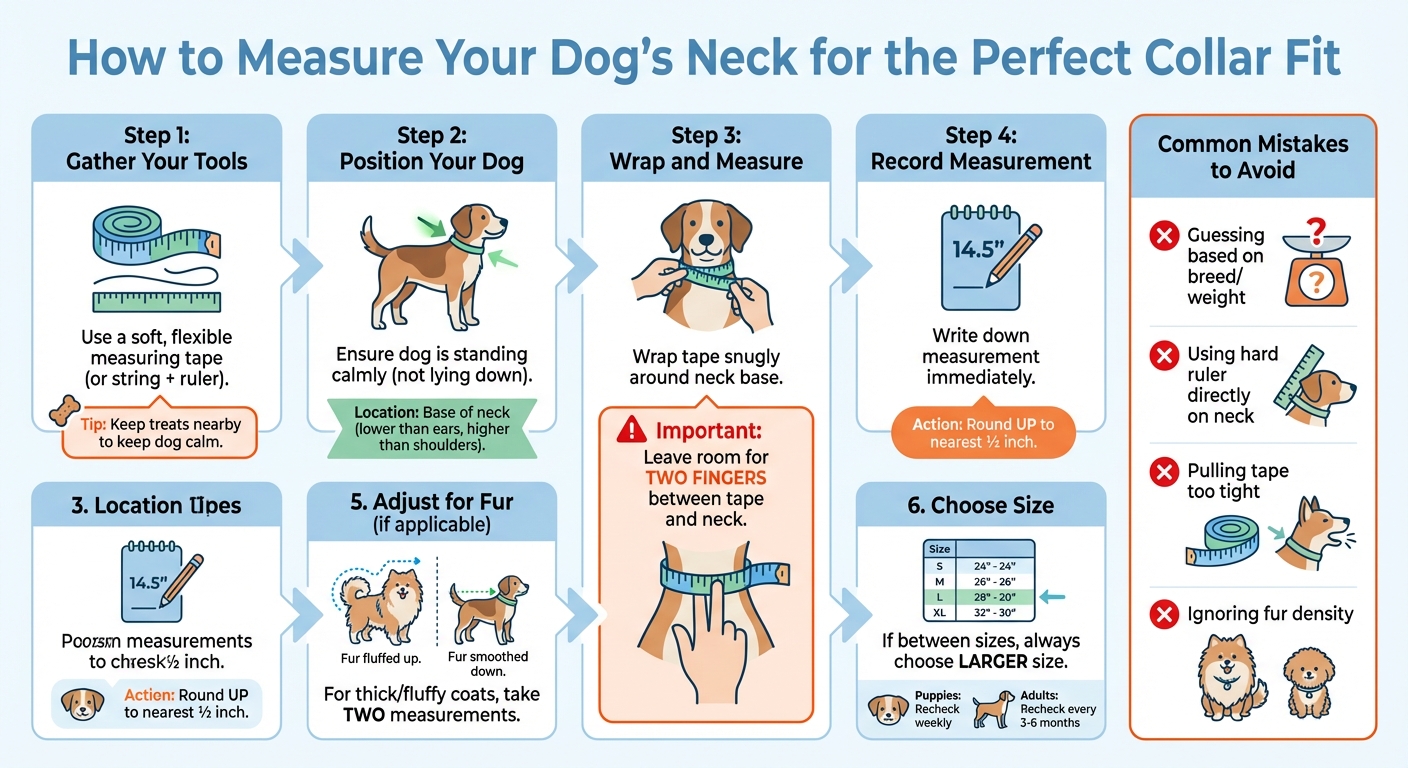
How to Measure Your Dog's Neck for the Perfect Collar Fit
Getting your dog's neck size right is key to finding a collar that fits well and feels comfortable. The best tool for this job? A soft, flexible measuring tape. It molds to your dog's neck shape, giving you an accurate reading. If you don’t have one, no worries - a piece of string, ribbon, or twine works just as well. Simply wrap it around your dog’s neck, mark the spot where it meets, and measure that length with a ruler. Keep a few treats nearby to help your dog stay calm and cooperative during the process.
Step-by-Step Measuring Instructions
To start, make sure your dog is standing calmly - avoid measuring when they’re lying down or overly energetic. Wrap the measuring tape snugly around the base of their neck, where a collar naturally sits. This is lower than the area behind their ears but not as low as the shoulders. Make sure to leave enough room to slide two fingers between the tape and your dog’s neck. Write down the measurement right away and round up to the nearest ½ inch.
For dogs with thick or fluffy coats, take two measurements - one with their fur fluffed up and another with it smoothed down. This helps you find a balance, ensuring the collar won’t be too tight when the fur compresses or too loose when it’s fluffed. If your measurement falls between two sizes on the collar chart, always go with the larger size and adjust it for a better fit. For puppies, remember to recheck their neck size weekly since they grow quickly and can outgrow collars in no time.
Keep reading to learn about common mistakes that can throw off your measurements.
Common Measurement Mistakes to Avoid
To get the best fit, steer clear of these common errors:
- Guessing based on breed or weight: This isn’t reliable. For example, a Boston Terrier and a Toy Poodle might weigh the same but have completely different neck sizes.
- Using a hard ruler directly on your dog’s neck: A rigid ruler can’t wrap around properly, leading to inaccurate readings.
- Pulling the tape too tight: The measuring tape should fit snugly, but you must still be able to insert two fingers underneath it.
Another common oversight is ignoring your dog’s fur density. Thick coats can lead to collars that are either too tight when the fur compresses or too loose when it’s fluffed. Also, consider the material of the collar. For instance, Ultrasuede doesn’t stretch over time like leather, so getting the size right initially is crucial. After fitting the collar, check for any signs of rubbing or discomfort to ensure your dog stays happy and safe.
The Two-Finger Rule for Collar Tightness
Once you've measured and secured your dog's collar, it's time to ensure the fit is just right using the two-finger rule. This simple and quick method is widely recommended by veterinarians and trainers as a reliable way to check if the collar is comfortable and secure.
The goal? A collar that fits "just right" - not so tight that it restricts breathing or causes irritation, but not so loose that it slips off. A well-fitted collar stays in place even if your dog pulls back, while also ensuring their safety and comfort.
How to Use the Two-Finger Rule
After fastening the collar, slide your index and middle fingers between the collar and your dog's neck, just behind the head. Here’s what to look for:
- If your fingers slide in with slight resistance, the fit is correct.
- If you struggle to insert your fingers or feel significant pressure, the collar is too tight.
- If more than two fingers - or even your hand - fits easily, the collar is too loose.
For smaller dogs or puppies under 10 lbs, use a one-finger fit instead, as their smaller necks make the two-finger method less proportional. Breeds like Chihuahuas and Yorkies, which are more prone to tracheal collapse, need extra attention to avoid unnecessary neck pressure.
Don’t forget to re-check the collar fit after grooming, as changes in fur volume can alter how the collar sits. Puppies grow quickly, so check their collars monthly during their first year. For adult dogs, a check every 3–6 months is usually sufficient. Regularly performing this test not only ensures your dog’s comfort but also helps prevent accidental escapes.
Why This Rule Works for Safety and Comfort
When paired with accurate neck measurements, the two-finger rule strikes the perfect balance between security and comfort. It prevents two major issues: choking from a collar that's too tight and the risk of escape from one that's too loose. Tight collars can cause serious problems like tracheal collapse in certain breeds, as well as chafing, redness, or even hair loss beneath the collar.
On the other hand, a loose collar can lead to a "backwards slip", where your dog pulls its head out and escapes. This is especially dangerous near traffic or in other high-risk areas. Loose collars are also more likely to get caught on objects like branches or furniture, which could result in injuries.
Even if the collar passes the two-finger test, stay alert for signs of discomfort. If your dog coughs or gags when you gently pull on the leash, the collar might be sitting too high on the windpipe or could be too narrow. In such cases, adjust the collar’s position or consider switching to a wider design for better comfort and safety.
Choosing and Adjusting Susan Lanci Designs Collars for a Secure Fit
Features of Susan Lanci Designs Collars
Susan Lanci Designs collars combine elegance and practicality, offering a luxurious yet secure option for your dog. Each collar is meticulously handcrafted in Southern California using Ultrasuede® - a high-performance synthetic microfiber. This material, often found in luxury cars and fashion, is softer than leather, resists stains and odors better than nylon, and holds its shape without stretching. It's also hypoallergenic, making it a great choice for dogs with sensitive skin, as it minimizes fur matting and promotes airflow.
These collars feature a patented sliding adjustment system with roller buckles, ensuring smooth adjustments without pinching. With sizes ranging from XS (8–12 inches) to large (16–24 inches), the design allows for a perfect fit, accommodating the recommended two-finger clearance with ease. Swarovski crystals, hand-set for added sophistication, enhance the collar's look without adding unnecessary weight, keeping your dog comfortable. The precise adjustment mechanism ensures that the collar delivers both style and safety for everyday wear.
Next, let’s dive into how to properly adjust the collar for your dog's unique size.
Adjusting Your Custom Collar for Your Dog's Size
Start with an accurate neck measurement and apply the two-finger rule for a comfortable fit. Add 2 inches to the neck measurement for small dogs, and 2–3 inches for medium to large breeds. Thread the buckle through the slider and adjust it to match the calculated size. Place the collar on your dog, ensuring you can comfortably slide two fingers under the collar at both the buckle and the opposite side. Adjust the slider as needed until the collar is snug but not restrictive.
To confirm the fit, lift the collar slightly while your fingers are underneath. It should stay in place without slipping over your dog’s ears or causing irritation. Take your dog for a short walk - about 10 minutes - to check for any signs of rubbing or discomfort. For puppies, recheck the fit monthly during their first year as they grow. For adult dogs, assess the fit every 3 to 6 months or after any noticeable weight changes.
"The soft material does have some give to it and allows for small adjustments... However, you will still need to properly measure your dog to ensure the perfect fitting." - Susan Lanci Designs
Collar Fit Guidelines by Dog Size and Breed
Small Breeds: Fitting Tips for Petite Dogs
Small dogs, such as Chihuahuas, Yorkshire Terriers, and Pomeranians, need extra attention when it comes to collar fit. Their delicate necks make them prone to injuries like collapsed tracheas or spinal issues if a collar exerts too much pressure. For reference, Chihuahuas typically have neck sizes of 8–14 inches and weigh 2–6 pounds, while Pomeranians measure around 10–14 inches with a weight range of 9–13 pounds.
For dogs under 10 pounds, add about 2 inches to their neck measurement and choose a lightweight collar, ideally around 0.6 inches wide, to minimize strain. Materials such as Ultrasuede® are ideal for small breeds because they are breathable and resistant to scratches. For fluffy breeds like Shih Tzus (neck sizes 10–14 inches, weights 12–16 pounds), measure both when their fur is fluffed and smoothed to find the best fit. Always apply the two-finger rule - ensuring two fingers can comfortably slide between the collar and the dog’s neck - to prevent tightness.
Be on the lookout for warning signs like coughing, gagging, or hair loss around the neck, as these may indicate the collar is too tight. For puppies, check the fit monthly, while adult small breeds should have their collars rechecked every 3–6 months, as even slight weight changes can impact their comfort and safety.
Medium and Large Breeds: Comfort and Security
Larger dogs require collars designed to evenly distribute pressure while providing a secure fit. For example, Beagles generally have neck sizes of 12–18 inches and weigh 18–30 pounds, while Labradors range from 18–24 inches and weigh between 55–80 pounds. Giant breeds, such as St. Bernards, can have massive neck sizes of 26–32 inches, paired with weights ranging from 140–260 pounds.
For these dogs, add 3 inches to the neck measurement to determine the right fit. Opt for wider collars, typically 1–1.5 inches, to help spread pressure evenly. For breeds with thick double coats, like German Shepherds, measure after grooming or when the fur is at its fullest. Even with wider collars, the two-finger clearance rule remains crucial for comfort.
Make sure your dog can move freely - eating, drinking, and turning its head without any restrictions. Check for red marks or signs of rubbing, as these can indicate the collar needs adjustment. Regularly recheck the fit every 3–6 months or after any noticeable weight fluctuations to ensure your dog’s collar stays comfortable and secure.
Conclusion
Getting the right collar fit boils down to three essentials: measuring your dog's neck accurately, applying the two-finger rule, and choosing high-quality materials to ensure both safety and comfort. The two-finger rule - sliding two fingers between the collar and your dog's neck - helps strike the perfect balance between snugness and freedom, ensuring your pup can breathe easily without the risk of slipping out.
Proper fit is especially important to avoid injuries. As highlighted by Susan Lanci Designs, small dogs are at greater risk of neck injuries from overly tight collars. Precision becomes even more crucial with designs like the "Perfect Fit" line, which features a quick-release buckle but lacks built-in adjustments, requiring exact initial measurements.
Premium materials like Ultrasuede® play a big role in your dog's comfort and safety. Unlike leather, Ultrasuede® maintains its shape over time, keeping your original measurement accurate for years. Plus, customers rave about its soft texture and long-lasting durability, making it a favorite for handcrafted collars.
Don’t forget to check your dog’s collar regularly, especially after grooming or weight changes. Puppies grow quickly, so frequent adjustments are a must. For dogs that pull during walks, consider using a harness to protect their neck, while keeping the collar for ID tags and style. Choosing the right fit is an investment in your dog's health, comfort, and happiness every single day.
FAQs
Should my dog wear a harness instead of a collar?
When deciding between a harness or a collar, it’s all about what works best for your dog. Collars are great for holding ID tags and are suitable for regular walks, as long as they fit properly - snug but with enough room to slide two fingers between the collar and your dog’s neck.
On the other hand, harnesses are a better choice for dogs that tend to pull on the leash, have breathing problems, or are at risk of neck injuries. This is because harnesses spread the pressure across the chest instead of concentrating it on the neck.
Many dog owners find it useful to have both a collar and a harness, using them as needed depending on the activity or situation.
What signs mean my dog’s collar fit is wrong?
A poorly fitting collar can lead to discomfort and even safety hazards for your pet. If the collar is too tight, it may cause irritation, restrict breathing, or result in injuries. On the other hand, a loose collar increases the chances of snagging on objects or your pet slipping out of it entirely.
Some warning signs to look out for include frequent snagging, difficulty breathing, or your pet persistently trying to remove the collar. To ensure a proper fit, always follow the two-finger rule - you should be able to slide two fingers comfortably between the collar and your pet's neck. Additionally, regularly inspect the collar for any signs of wear or damage to keep your pet safe and comfortable.
How do I fit a collar on a thick or fluffy coat?
To properly fit a collar on a dog with a thick or fluffy coat, make sure it’s secure yet comfortable. Use the two-finger rule: you should be able to slide two fingers easily between the collar and your dog’s neck. This ensures the collar isn’t too tight, avoiding irritation, discomfort, or fur matting. Be sure to adjust the collar as needed, especially after grooming or if your dog’s coat changes in thickness.