


Finding the right harness size for your dog is crucial for their comfort and safety. A well-fitted harness distributes pressure evenly, reducing strain on the neck and chest and preventing escapes. Here's how to measure your dog and avoid common sizing mistakes:
- Chest Girth: Measure the widest part of your dog's rib cage, just behind the front legs. Use the largest of three measurements for accuracy.
- Neck Circumference: Measure the base of the neck, above the shoulders, where the harness will sit. Apply the two-finger rule for a snug but comfortable fit.
- Weight and Breed Consideration: Weight alone isn’t reliable. Dogs of similar weight can have different body shapes. Always prioritize measurements over weight.
If your dog’s size is between two options, choose the larger size and adjust the straps for a secure fit. Regularly check and adjust the harness, especially for growing puppies or after grooming. Brands like Susan Lanci Designs offer detailed size charts and customizable options for a tailored fit.
Avoid relying solely on weight, measuring incorrectly, or overlooking breed-specific needs. A proper harness fit ensures a safe and enjoyable experience for both you and your dog.
How to Measure Your Dog for a Harness
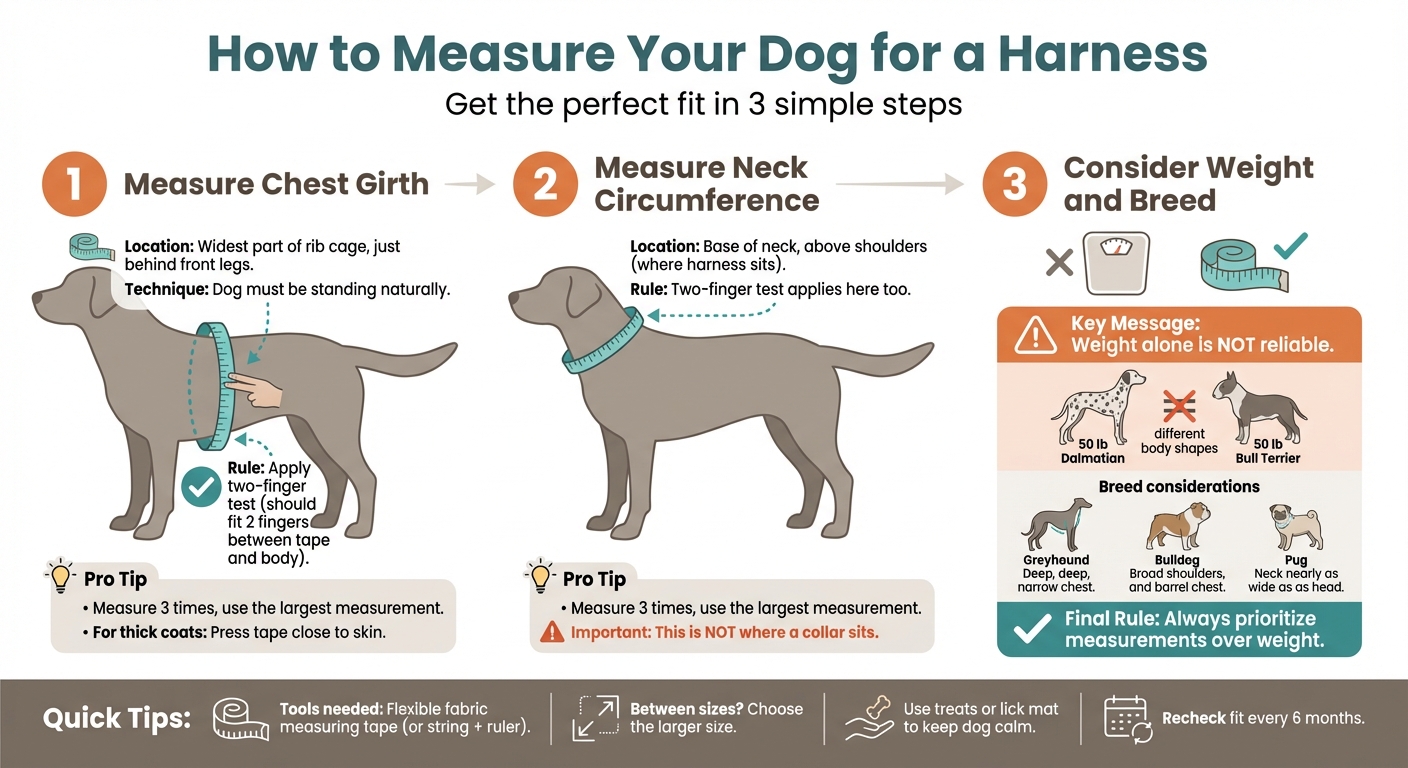
How to Measure Your Dog for a Harness in 3 Steps
Getting the right harness for your dog starts with accurate measurements. A proper fit ensures comfort and safety, so it’s worth taking the time to measure carefully. Use a flexible fabric measuring tape, like the kind tailors use. If you don’t have one, a piece of string and a ruler will do the trick. To account for any movement, measure three times and use the largest result.
Step 1: Measure Chest Girth
The chest girth is the most crucial measurement. This is the widest part of your dog’s rib cage, located just behind the front legs. Make sure your dog is standing naturally on all fours so their rib cage is fully expanded.
Wrap the tape around this widest point, keeping it snug but not tight. You should be able to slide two fingers between the tape and your dog’s body. If your dog has a thick coat, press the tape close to the skin for an accurate reading. To keep your pup calm, try using treats or a lick mat during the process.
Step 2: Measure Neck Circumference
Next, measure the neck at its base, just above the shoulders where the harness will sit. Use the same two-finger rule to ensure the tape is snug but not restrictive.
For breeds with unique body shapes, like Whippets or Bulldogs, neck measurements can be more important than weight. Measure three times and use the largest result to ensure accuracy.
Step 3: Consider Weight and Breed
While weight can provide a rough estimate, it’s not always reliable. Two dogs weighing 50 pounds can have completely different body shapes. For example, a lean Dalmatian and a stocky Bull Terrier won’t fit the same harness.
Breed-specific traits also play a role. Greyhounds have deep, narrow chests, while Bulldogs have broad shoulders and barrel chests. For brachycephalic breeds like Pugs, their necks may be nearly as wide as their heads, which impacts the harness fit. Always prioritize your dog’s measurements over weight or general size charts. If your dog’s measurements fall between two sizes, choose the larger size and adjust the straps for a secure, comfortable fit. This attention to detail ensures your dog’s harness will provide both comfort and safety.
sbb-itb-c3a5f9c
Susan Lanci Designs Harness Size Chart
When it comes to finding a harness that’s both stylish and secure for your dog, accurate sizing is key. Susan Lanci Designs offers a range of sizes tailored to fit dogs of various shapes and sizes.
Size Chart Overview
Susan Lanci Designs offers two harness styles, each with its own sizing system. The Step-In Harness is available in 11 sizes, including half-size options like XS/S and S/M, which are perfect for dogs with measurements that fall between standard sizes. On the other hand, the Tinkie Harness comes in 7 sizes, featuring adjustable neck and chest straps for a more tailored fit.
The sizing is based entirely on chest girth to ensure the best fit. For instance, while a Boston Terrier and a Toy Poodle may weigh the same, their chest measurements are likely to differ significantly.
| Step-In Harness Size | Chest Girth |
|---|---|
| TC (Teacup) | 8 1/2" - 9 1/2" |
| XXS | 9 1/2" - 10 1/2" |
| XS | 10 1/2" - 12" |
| XS/S | 11 1/2" - 13" |
| S | 12 1/2" - 14" |
| S/M | 13 1/2" - 15" |
| M | 14 1/2" - 16" |
| M/L | 16" - 18" |
| LG | 18" - 20" |
| LG/XL | 20" - 22" |
| XL | 22" - 24" |
| Tinkie Harness Size | Chest Girth |
|---|---|
| TC | 7 1/2" - 10" |
| XXS | 8 1/2" - 10 1/2" |
| XS | 10" - 12" |
| SM | 12" - 14" |
| MD | 14" - 16" |
| LG | 15" - 17" |
| XL | 17" - 20" |
The harnesses are crafted from Ultrasuede®, a material that maintains its shape while allowing minimal stretch. If your dog’s chest girth is near the upper limit of a size - or if they have a thick coat or broader chest - opting for the next size up is recommended. Pricing varies by style, ranging from about $70.00 to $125.00.
Custom-Fit Options for Luxury Harnesses
For dogs with unique measurements, Susan Lanci Designs provides custom and made-to-order options through authorized boutiques. These personalized harnesses typically require additional processing time and are non-returnable due to their tailored nature. The Tinkie Harness, with its independent neck and chest adjustments, is particularly suited for breeds with unusual body shapes or dogs whose measurements fall at the edges of standard sizes. If you’re unsure which size is right, customer service is available to help you find the perfect fit for your furry friend.
Harness Fit Checklist
Once you've chosen the right harness size, take a moment to double-check the fit to ensure your dog stays comfortable and secure.
Chest and Neck Measurements
Begin by verifying that your dog's measurements align with the size chart you used. Measure the chest girth at the widest part of the rib cage, just behind the front legs. For the neck, measure the thickest area above the shoulders - this is not where a collar typically sits. If your dog's measurements fall between two sizes, go with the larger option for a better fit.
Two-Finger Rule for Comfort
The two-finger test is a simple way to check the harness fit. Slide two fingers between the harness and your dog's body - this should be possible at both the chest and neck straps. A proper fit prevents the harness from sliding side-to-side or allowing your dog to slip out. Always perform this test while your dog is standing naturally, as their proportions can shift when sitting or lying down. For added peace of mind, gently pull the harness forward - if it slips off, tighten it until it stays secure.
Breed-Specific Adjustments
Your dog's body shape plays a key role in harness selection and adjustment. For breeds like Bulldogs and Pugs, whose necks are almost as wide as their heads, a multi-contact harness is essential to prevent slipping. Dogs with thick or fluffy coats may need slightly tighter straps, but make sure the harness doesn’t restrict their movement. Observe how your dog walks or runs immediately after fitting. Check under the arms for signs of discomfort, such as red marks, chafing, or missing fur - these are clear indicators that adjustments are necessary. Reassess the fit every six months or after grooming, especially if your dog’s coat has been trimmed significantly. These small adjustments ensure a snug and safe fit every time.
Common Sizing Mistakes to Avoid
Even with a size chart in hand, sizing errors can still happen, potentially affecting both comfort and safety. Here’s a closer look at some common missteps and how to steer clear of them.
Mistake: Relying Only on Weight
Weight might seem like a convenient guideline, but it falls short when it comes to accounting for differences in body proportions. For example, two dogs of the same weight can have dramatically different chest and neck measurements. Interestingly, chest girth determines about 90% of a harness's fit success. Breeds like Bulldogs, with barrel-shaped chests, need deeper chest straps compared to leaner breeds like Whippets. For the best fit, always measure the widest part of your dog’s rib cage, just behind the front legs, and use weight as a secondary consideration. Also, keep in mind how growth patterns, especially in puppies, can influence sizing.
Mistake: Wrong Size for Growing Puppies
Puppies grow quickly, so if your pup’s measurements fall between two sizes, it’s better to go with the larger one. Look for harnesses with four to five adjustment points to accommodate their rapid growth. For large breed puppies, maturity can take 12–18 months, meaning regular re-measurements - about every six months - are crucial to maintaining a proper fit. Timing your measurements correctly is just as important as the measurements themselves.
Mistake: Incorrect Measurements
Measuring at the wrong moment or in the wrong way can lead to a poor fit. Always measure your dog while they’re standing naturally to get accurate dimensions. Ensure you measure the broadest part of the neck, just above the shoulders. If your dog has a thick or fluffy coat, press the measuring tape snugly against their body to account for fur compression once the harness is on. Double-checking these details can make all the difference in finding the perfect fit.
Conclusion
Getting the right harness fit starts with accurate measurements, not just weight estimates. As Susan Lanci Designs explains, "A Boston terrier and a toy poodle won't have the same measurements even if they are close to the same weight". Measuring the widest part of your dog's rib cage is key to ensuring both comfort and safety.
A well-fitted harness does more than just keep your dog secure - it also safeguards their health. It helps distribute pressure evenly, reducing the risk of issues like collapsed tracheas, neck injuries, or spinal strain. Using the two-finger rule and observing your dog's movement can help confirm that the harness fits properly and comfortably.
Harnesses made from Ultrasuede offer durability and comfort over time. With proper care, Ultrasuede retains its shape, ensuring the harness stays secure through countless walks.
Susan Lanci Designs takes fit seriously, offering up to 11 sizes in select harness styles. Each harness is custom-made using premium Ultrasuede and adorned with genuine Swarovski crystals, combining precision with lasting quality.
FAQs
Can my dog slip out of a harness even if it’s the right size?
Yes, even a harness that’s the right size can be slipped out of if it isn’t adjusted or fastened properly. Make sure the harness fits snugly without being too tight, and look for safety features like secure closures to prevent your dog from slipping free. Proper adjustments are key to keeping your dog both safe and comfortable.
What should I do if my dog’s harness rubs under the arms?
If your dog’s harness is causing rubbing under the arms, start by checking the fit. The girth strap should be snug enough to stay in place but not so tight that it restricts movement. Make sure the chest strap sits gently across the front without pressing too hard. A loose girth strap can slide into the armpits, leading to irritation. Adjust the harness for a better fit, and if the problem persists, consider adding padding or switching to a harness made from softer materials to keep your pup comfortable.
How often should I re-measure my dog for a harness?
Regularly measure your dog to ensure their harness fits snugly and comfortably. This is particularly important if your dog is still growing, has experienced weight changes, or if the harness starts to feel off. Routine checks are key to keeping your pet safe and comfortable.